Ukaresh's overgrowth
Chasing SunlightUkaresh's overgrowth is the state produced when sunlight changes the nature of the Black Garden and causes it to erupt through Ukaresh. The transformation turns the eastern city from an already unstable but functioning settlement into a temporary forest of hungry, animated growth. It is both an immediate escape crisis for Jonathan Heights and Eleanor McAvey and a lasting alteration to a city governed according to power rather than ordinary law.
Origin in the Black Garden
The overgrowth begins in the Pits of the Condemned, where Jonathan uses his faith in sunlight to drive back the Black Garden's dark, grasping vegetation. The light does not simply destroy the Garden. Through Eleanor McAvey, it observes and absorbs the illumination, combining with Jonathan's memory and changing into something greener and greater. The new form remains consuming even after its color changes, so the encounter is not a victory over the Garden but an exchange that gives its hunger a new expression.
The transformation first becomes visible through the Keeper of the Pits. Something claws its way out of Eleanor McAvey and bathes in the radiance of Jonathan's memory, while the Keeper gains two woody limbs before its barrel-like body bursts apart. A blood-slick trunk shoots toward the ceiling and roots crack the stone floor. Eleanor McAvey screams and bleeds from her eyes, tongue, and nails as the surrounding pits tremble; then hundreds of trees rise, one from each pit, making the ground shake and the ceiling shudder. The Garden has crossed from Eleanor McAvey's body and the buried prison into the architecture of Ukaresh itself.
Jonathan eventually extinguishes the sunlight, and the scorching radiance fades from his mind, but the intervention has already become irreversible in the immediate crisis. Eleanor McAvey collapses, while the Black Garden continues growing and sends limbs through the ceiling. As stone falls into the Pits, Jonathan drags her toward the stairs and sees one of the identical defiled engravings smiling, a final sign that the eruption is not merely botanical growth but a disturbing change in the city's hidden reality.
Spread through Ukaresh
Jonathan carries the comatose Eleanor McAvey through the passages beneath Ukaresh, where the city's unusual stability prevents the tunnels themselves from collapsing even as branches wind through the open spaces. The normal dangers of the city are temporarily reversed: creatures that might usually prey on an unwary traveler become targets of the shifting, rustling trees. Jonathan uses that confusion to rush through the warrens, carrying Eleanor McAvey in his arms and keeping his cane hooked over one arm.
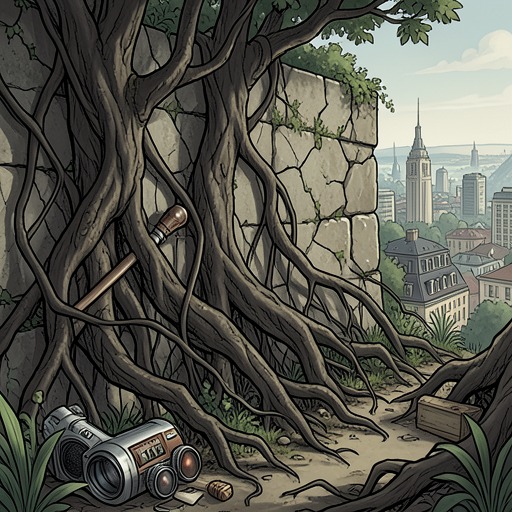
When he emerges from the underground passages, Ukaresh has become a dense forest. Dark green leaves glitter as they absorb whatever light reaches them, replacing the city's already strange mixture of buildings, bridges, tunnels, and colored illumination with an environment that behaves like an organized threat. The transformation does not respect the distinction between natural growth and urban construction. Branches move with malevolent intent, while stalled conveyances, buildings, shops, and monstrous inhabitants obstruct one another or fight back amid the upheaval.
Jonathan runs through streets crowded with wheeled, legged, and otherwise mobile vehicles, jumping around them and ducking branches. A falling trunk groans and snarls as twigs lash like knives, and he gains height by vaulting onto an angled storefront. The rooftops cannot form a continuous route because Ukaresh's architecture includes domes, pyramids, slopes, and open ceilings, but they still offer shortcuts. From above, he sees that parts of the city have already been cleared, while the area around the palace is being actively reshaped: trunks and branches are twisted into other forms, suggesting that the overgrowth is confronting the city's ruling power rather than simply spreading without resistance.
Ukari and the crisis of power
The city trembles when Ukari stirs in her distant palace, and Jonathan recognizes that She-Who-Must-Be-Obeyed could clear the overgrowth with a gesture if she chose to do so. He also understands that she may permit it to remain, because challenges help keep Ukaresh honest under its power-based order. The danger therefore lies not only in the plants themselves but in what Ukari's response will mean. Jonathan has introduced a living force into a city whose stability depends on the ability of its strongest power to contain violence and disorder.
The overgrowth exposes the limits of Ukaresh's apparent order. Ukaresh is neither completely lawless nor orderly: personal violence is possible, but anything threatening to become a wider disturbance is suppressed with murderous enthusiasm. The Garden interrupts that arrangement by turning the city's own structures and inhabitants into participants in a spreading emergency. Its branches hunt creatures, its growth obstructs movement, and its scale forces even the palace to react. Jonathan later tells Antomine that the errand itself succeeded, but sunlight appears to have changed the Black Garden permanently; it has learned something, and Ukaresh's disposition has been altered.
This change also reverses the usual direction of power within the city. In ordinary Ukaresh, dangerous beings control their conduct because they fear the consequences of attracting the attention of stronger beings. During the overgrowth, those inhabitants flee or fight while the vegetation itself becomes an active predator. The city's dominant principle remains visible, but the source of dominance has become unstable: the question is no longer simply which inhabitant possesses greater power, but whether the city can absorb a new form of life that has been educated by sunlight.
Escape aboard the Endeavor
Jonathan reaches Crispin's lodging after crossing the transformed streets and finds a branch growing through a window. He climbs to the pavilion where the Endeavor is tethered, while three crewmen hack at encroaching twigs to keep the lines clear. Rather than wait for the growth to close around the mooring place, he jumps onto the descent line with Eleanor McAvey in one hand and steadies himself with the other. He orders the crew to release the tethers and come up, and the airship rises as the men are hauled aboard.
Once on deck, Jonathan passes the unconscious Eleanor McAvey to her attendants and orders the Endeavor to depart as quickly and as high as possible. Antomine challenges him because the expedition's supposed errand has produced a catastrophe in a foreign port. Jonathan answers that the errand went well but that he had needed to prevent Eleanor McAvey from hurting herself. His explanation identifies the decisive mechanism of the event: sunlight has effects beyond illumination, and exposure has altered the Black Garden rather than merely suppressing it.
Antomine interprets the result as evidence for the Inquisition's caution. From his perspective, Jonathan leaves destruction behind wherever he acts, regardless of whether the immediate objective is achieved. Jonathan dismisses that judgment, but the escape makes the cost plain. Eleanor McAvey is incapacitated, Ukaresh is overgrown, and the Endeavor must flee before Ukari decides whether the new growth is an enemy, a challenge, or a useful addition to the city.
Meaning and aftermath
Ukaresh's overgrowth turns a city already defined by blended species, unstable landmarks, and architectures that grow into the landscape into a literal forest. Earlier, Ukaresh seemed to emerge from the eastern terrain rather than stand against it; after the Black Garden's transformation, the boundary between city and wilderness is no longer merely ambiguous. Vegetation invades streets, buildings, tunnels, and rooftops, while the urban environment becomes part of the Garden's expansion. The state therefore intensifies a condition that was already characteristic of Ukaresh instead of introducing an entirely foreign principle.
The event also contrasts with the engineered illumination of Beacon and the frontier infrastructures encountered elsewhere. Beacon's white stone and Zint-light present civilization as a controlled, artificial answer to darkness, while Ukaresh blends subdued radiance with tangled growth and nonhuman forms. The overgrowth reveals the danger hidden in that contrast: sunlight, which Jonathan treats as pure and truthful, does not restore a simple human order when it enters an alien ecology. It produces knowledge in the Garden, and that knowledge becomes growth, appetite, and spatial upheaval.
The immediate crisis ends when the Endeavor escapes, not when the overgrowth is defeated. Jonathan specifically recognizes that the disposition of Ukaresh has been permanently altered. The state thus functions as a consequence rather than a closed battle: the city survives, but its relationship with the Black Garden, sunlight, and Ukari's authority has changed. Its forested form is the visible residue of Jonathan's attempt to use sunlight as a weapon, and it demonstrates that revelation can transform what it touches as radically as darkness can conceal it.